
Argentine Firebox Drop-Ins: The Ultimate Guide to Wood Fired Grill Inserts for Outdoor Kitchens in 2026
A true outdoor cooking experience starts with more than just a grill—it starts with a well-designed firebox. Whether you're building a custom masonry barbecue, an outdoor kitchen, or a dedicated Argentine grilling station, the firebox is the heart of the entire system. Unfortunately, many DIY builds and pre-fabricated inserts are constructed with thin materials, poor airflow, and limited durability, resulting in uneven heat, excessive maintenance, and disappointing cooking performance.
Argentine-style grilling has become increasingly popular because it delivers something gas grills simply can't replicate: the unmistakable flavor and cooking control that comes from cooking over a live wood or charcoal fire. But achieving consistent results requires more than just a grate over a fire pit. The quality of the firebox determines how efficiently fuel burns, how evenly heat is distributed, and how long the system will last under years of high-temperature use.
In this guide, we'll explore what makes a high-quality Argentine drop-in firebox, how to choose the right size and material for your project, and the key features that separate a professional-grade system from a basic backyard build. We'll discuss firebox construction, material selection, airflow considerations, and the benefits of integrating Argentine V-grates for superior grease management and flare-up control.
Whether you're designing a custom outdoor kitchen, upgrading an existing masonry pit, or building your dream Santa Maria or Argentine-style grill from the ground up, understanding the role of the firebox is the first step toward creating a cooking system that delivers exceptional performance for decades to come.
Key Takeaways
- Stop settling for flimsy retail components and learn how high-performance upgrades can turn your grill into a permanent backyard legacy.
- Master the mechanics of Santa Maria and Argentine height-adjustment systems to take total control over your cooking temperatures.
- Decode the science of 304 stainless vs. carbon steel so you can select the right metal for your environment and flavor profile.
- Follow our professional measuring guide for custom bbq parts to ensure your masonry pit inserts fit perfectly and allow for natural metal expansion.
- Gain the confidence to invest in factory-direct, American-made quality that prioritizes precision engineering over mass-market shortcuts.
Beyond the Flame: Why a High-Performance Argentine Grill Matters
An Argentine grill is more than just a place to cook food—it's the centerpiece of an outdoor cooking experience. Unlike mass-produced grills designed around convenience, a true Argentine-style grill gives you complete control over heat, fuel, and flavor. From slow-cooking large cuts of meat to achieving the perfect sear over hardwood coals, the quality of the grill itself plays a major role in the final result.
Unfortunately, many outdoor cooking systems are built with thin materials, limited heat control, and components that deteriorate after only a few seasons of use. While these grills may look impressive on day one, they often struggle to withstand the high temperatures and demanding conditions that come with cooking over live fire. For those investing in a custom outdoor kitchen or masonry grill island, the cooking system should be built to last for decades, not just a few years.
That's why our Argentine Drop-In Grill is engineered as a complete cooking system rather than simply a cooking grate over a fire pit. At its foundation is a fully welded firebox designed to handle years of wood and charcoal cooking while promoting efficient airflow and consistent heat. Above the firebox, a height-adjustable main cooking grate allows you to precisely control cooking temperatures by raising or lowering food relative to the fire. A full-width warming rack positioned above the crank system provides additional cooking space while keeping finished foods warm without overcooking.
To accommodate different cooking styles and grill sizes, our Argentine grills are available in both single-crank and dual-crank configurations. The single-crank design offers simple, reliable operation, while the dual-crank setup allows independent control of multiple cooking zones, making it easier to manage different foods and temperatures simultaneously.
The result is a grill that combines traditional Argentine cooking principles with heavy-duty American fabrication. Whether you're building a backyard gathering space, a luxury outdoor kitchen, or a commercial cooking area, a properly designed Argentine grill delivers unmatched versatility, precise heat control, and the authentic wood-fired flavor that has made this style of cooking popular around the world.
The Failure of Big-Box BBQ Components
Why a Purpose-Built Argentine Grill Makes a Difference
Many backyard grills are designed around convenience and affordability rather than long-term performance. Thin materials, limited heat control, and fixed cooking surfaces may work for occasional grilling, but they often struggle to deliver the consistency and versatility that live-fire cooking demands. When cooking over wood or charcoal, precise heat management becomes just as important as the quality of the food itself.
A properly designed Argentine grill takes a different approach. Built around a heavy-duty firebox and a height-adjustable cooking grate, it gives the cook complete control over the distance between the food and the fire. Instead of trying to control temperature with burner knobs, you manage heat the traditional way—by adjusting the cooking surface relative to the coals. This allows for everything from intense searing to slow, controlled roasting over a live fire.
Durability is equally important. An Argentine grill is often the centerpiece of a custom outdoor kitchen or masonry installation, making long-term reliability a priority. Heavy-duty construction, fully welded assemblies, and quality materials help ensure the grill can withstand years of high-temperature cooking while maintaining smooth operation and structural integrity.
The result is more than just a grill—it's a cooking system designed to provide precise control, exceptional versatility, and the authentic wood-fired flavor that has made Argentine grilling a favorite among outdoor cooking enthusiasts around the world.
The Live Fire Advantage: Parts for Wood and Charcoal
One of the greatest advantages of an Argentine grill is its ability to cook over a live wood or charcoal fire. Unlike gas grills that rely on fixed burners and preset heat levels, live-fire cooking allows you to control flavor, temperature, and cooking intensity in ways that simply aren't possible with conventional grilling methods. The result is a richer cooking experience and the unmistakable flavor that only real wood and charcoal can provide.
However, cooking over live fire places unique demands on the grill itself. High temperatures, fluctuating heat zones, and the weight of large cuts of meat require a cooking system built for strength and reliability. That's why quality construction matters. A heavy-duty firebox, robust cooking grates, and a dependable crank mechanism work together to provide precise heat control while standing up to years of demanding use.
The adjustable grate system is what truly sets an Argentine grill apart. By raising or lowering the cooking surface, you can instantly manage cooking temperatures without moving fuel or disrupting the fire. Whether you're searing steaks over glowing embers, slowly roasting ribs, or holding finished food on the warming rack, the ability to fine-tune heat gives you complete control over the cooking process.
Our Argentine Drop-In Grills are built with heavy-duty fabrication, smooth-operating crank systems, and fully welded construction to handle the challenges of live-fire cooking. Available in both single- and dual-crank configurations, they provide the versatility, durability, and performance needed to become the centerpiece of any outdoor kitchen or custom masonry grill project.
Santa Maria and Argentine grills represent some of the most versatile and rewarding forms of live-fire cooking. Unlike conventional gas grills, where temperature is controlled by adjusting burner output, these traditional cooking systems are built around a different philosophy: maintain a consistent fire and control the heat by adjusting the cooking surface. This approach gives the cook exceptional control over the cooking process while preserving the authentic flavors that only wood and charcoal can provide.
The defining feature of both grill styles is the adjustable cooking grate. Using a crank system, the grate can be raised or lowered to control the distance between the food and the fire. Lower positions provide the intense heat needed for searing steaks and chops, while higher positions allow for slower cooking, roasting, and holding food without overcooking. This simple but effective design gives cooks the flexibility to prepare a wide variety of foods over a single fire.
In traditional Argentine grilling, fire management is just as important as the cooking surface itself. Many authentic setups incorporate a brasero, or fire basket, where hardwood logs are burned down into clean, glowing embers. Once the wood has produced a bed of quality coals, those embers are transferred beneath the cooking grate to create a controlled cooking environment. This process helps produce the clean, wood-fired flavor that Argentine grilling is known for while minimizing excess smoke and flare-ups.
A well-designed Argentine grill combines these traditional cooking principles with heavy-duty construction. Features such as a fully welded firebox, adjustable crank-operated grates, and upper warming racks provide the durability, heat control, and versatility needed for everything from quick weeknight meals to large gatherings. Whether configured with a single crank or dual independent cooking zones, these systems are designed to deliver precise control and exceptional live-fire cooking performance for years to come.
The Lifting Mechanism: Cranks, Cables, and Pulleys
The adjustable grate system is one of the defining features of an Argentine grill and one of the primary reasons these grills offer such exceptional cooking control. By allowing the cooking surface to be raised or lowered relative to the fire, the lifting mechanism gives the cook precise control over cooking temperatures without disturbing the fire itself. Whether you're searing steaks over intense heat or slowly roasting larger cuts, smooth and reliable grate adjustment is essential.
Because the lifting system is subjected to high temperatures, heavy loads, and repeated use, its construction matters. A properly engineered system should operate smoothly even when supporting a fully loaded cooking grate. Quality cables, pulleys, bearings, and crank components help ensure consistent performance while providing the strength and durability required for years of live-fire cooking.
Some grill manufacturers take a different approach by designing systems that raise and lower the firebox or coal bed rather than the cooking grate. While these designs can provide temperature control, they also place the lifting mechanism directly in one of the hottest areas of the grill. Over time, repeated exposure to extreme heat, ash, and burning embers can increase wear on moving components and create additional maintenance requirements.
Traditional Argentine grill designs avoid this challenge by keeping the firebox fixed and adjusting the cooking grate instead. By locating the lifting components farther from the most intense heat, the system can provide smooth operation, greater reliability, and a longer service life while still delivering precise temperature control.
Our Argentine grills utilize heavy-duty lifting components designed to withstand the demanding conditions of wood and charcoal cooking. Aircraft-grade stainless steel cables provide excellent corrosion resistance and long-term reliability, while precision-machined crank assemblies allow for smooth grate adjustments with minimal effort. Combined with a fully welded firebox and heavy-duty cooking grates, the result is a durable cooking system designed to provide decades of dependable live-fire cooking performance.
Cooking Surfaces: V-Grates vs. Stainless Round Rods
The cooking surface is one of the most important decisions you'll make when designing an Argentine grill. While Argentine V-grates, stainless round rod grates, and laser-cut grates all deliver excellent results, each offers distinct advantages that appeal to different cooking styles and preferences.
Argentine V-grates are the traditional choice and have become synonymous with authentic Argentine-style grilling. Their angled profile is designed to channel rendered fat and juices away from the fire and into a collection trough below. By reducing direct contact between grease and the coals, V-grates help minimize flare-ups while creating a cleaner, more controlled cooking environment. This design makes them especially popular for cooking richly marbled steaks, sausages, and larger cuts of meat over a live wood or charcoal fire.
Many imported Argentine-style grates are manufactured from thin folded sheet metal to reduce cost and weight. In contrast, our Argentine V-grates are built from heavy-duty stainless steel angle iron, creating a stronger and more durable cooking surface designed for serious live-fire cooking. The substantial material mass provides excellent heat retention, superior resistance to warping, and the traditional V-channel design that efficiently directs grease away from the fire for cleaner, more consistent cooking.
Stainless round rod grates offer a different set of benefits. Their open design promotes excellent airflow around the food while creating the bold grill marks many outdoor cooks prefer. Round rod grates are exceptionally durable and easy to clean, making them a popular choice for both residential and commercial applications. For maximum durability and heat retention, we recommend a minimum rod diameter of 3/8 inch. Heavier rods store more heat, provide more consistent cooking performance, and are significantly more resistant to warping than the thinner materials commonly found in mass-produced grills.
Laser-cut grates provide a modern alternative that combines strength, precision, and a distinctive appearance. Fabricated from thick steel or stainless steel plate, laser-cut grates offer exceptional structural rigidity and can be customized with unique patterns, branding, or cooking surface designs. Their increased mass helps retain heat for consistent cooking temperatures, while the solid construction makes them well suited for high-output wood and charcoal cooking systems. Many outdoor kitchen designers choose laser-cut grates for their clean aesthetics, durability, and ability to create a truly custom grilling experience.
There is no single "best" cooking surface—only the one that best matches your cooking style and preferences. Argentine V-grates excel at grease management and traditional live-fire cooking, round rod grates offer simplicity and classic grill marks, and laser-cut grates deliver exceptional durability with a distinctive custom appearance.
Whether paired with a single-crank or dual-crank Argentine grill system, all three grate styles can provide outstanding performance when supported by a heavy-duty firebox and precision lifting system. The key is choosing a cooking surface that complements the way you cook and the experience you want to create around the fire.
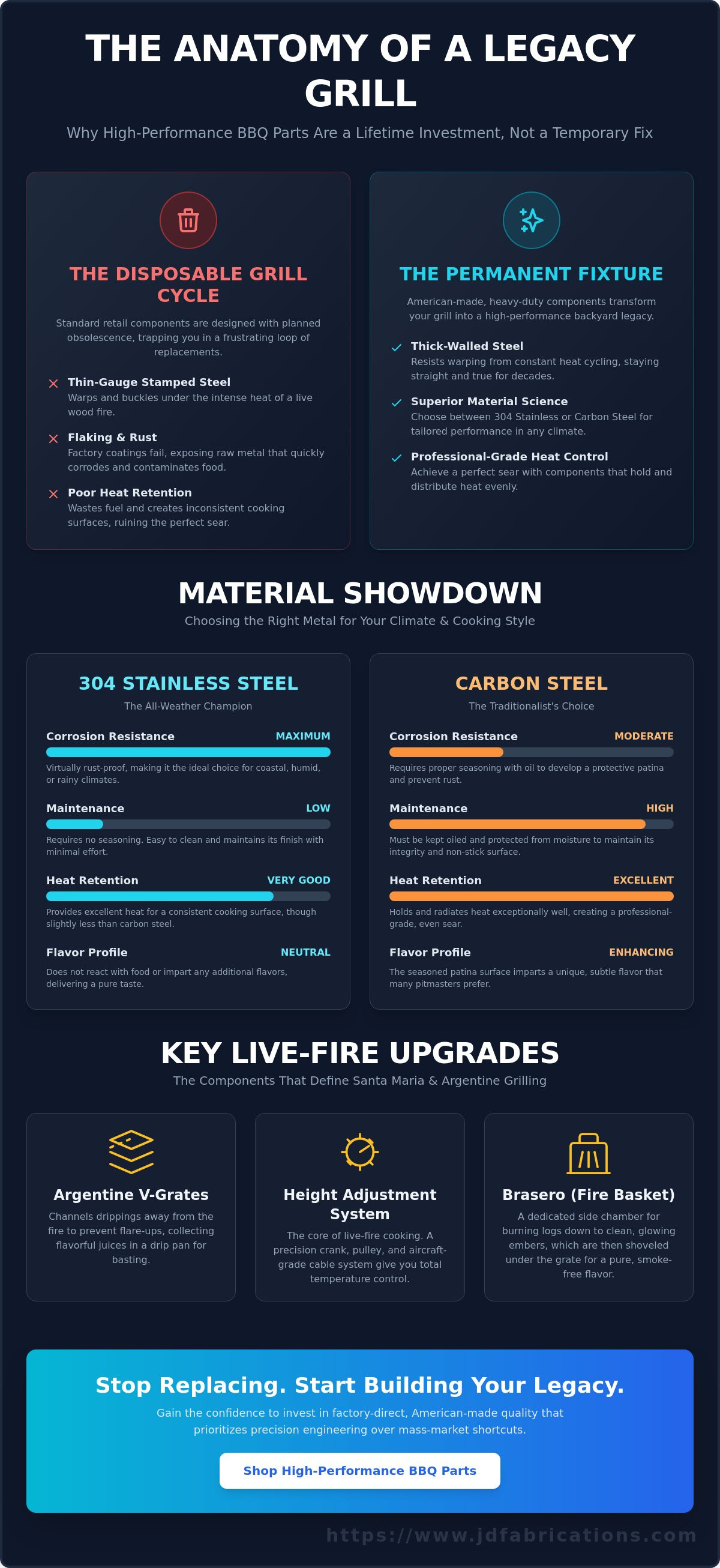
Material Science: Choosing Between Stainless and Carbon Steel
The materials used to build an Argentine grill play a significant role in its durability, appearance, and long-term performance. Whether you're designing a custom outdoor kitchen or installing a drop-in Argentine grill, selecting the right material helps ensure your investment continues to perform for years to come.
Material thickness is often one of the first indicators of quality. Live-fire cooking generates extreme temperatures that can place significant stress on a grill's structure over time. Heavy-duty construction helps resist warping, improves heat retention, and provides the strength needed to support large cooking surfaces and repeated heating cycles. For structural components such as fireboxes, frames, and cooking systems, 3/16-inch and 1/4-inch material thicknesses are widely regarded as the benchmark for premium live-fire cooking equipment.
The choice between stainless steel and carbon steel largely depends on your environment, maintenance preferences, and desired appearance.
Stainless steel offers outstanding corrosion resistance and is an excellent choice for coastal environments, outdoor kitchens exposed to the elements, or owners seeking minimal maintenance. It maintains its appearance over time, cleans easily, and provides exceptional longevity when properly fabricated.
Carbon steel remains a favorite among many live-fire cooking enthusiasts because of its strength, traditional appearance, and ability to develop a natural patina through use. With proper care and routine maintenance, carbon steel can provide decades of reliable service while developing the character and appearance many pitmasters appreciate.
Both materials are capable of delivering exceptional performance when built with proper design and sufficient material thickness. The best choice ultimately depends on your climate, maintenance expectations, and the overall aesthetic you want for your outdoor cooking space.
When investing in an Argentine grill, it's important to look beyond appearance alone. Construction quality, material thickness, and fabrication methods often have a greater impact on long-term performance than the material itself. A well-built grill constructed from quality materials can provide decades of dependable service while becoming a centerpiece of outdoor gatherings for years to come.
Measuring Your Masonry Pit for Custom BBQ Part Inserts
A custom masonry grill island or outdoor kitchen can become the centerpiece of an outdoor living space, but achieving a professional result starts with accurate measurements. Whether you're installing a complete Argentine grill system, a Santa Maria grill, or a custom drop-in firebox, proper planning ensures the finished installation looks great and operates smoothly for years to come.
One of the most common mistakes homeowners make is assuming masonry openings are perfectly square. In reality, brick, block, and stone construction often contain slight variations that can affect fitment. Taking accurate measurements and accounting for installation clearances helps avoid costly modifications during installation.
Step 1: Measure the Opening at Multiple Locations
Measure the inside width and depth of the masonry opening at the top, middle, and bottom. Because masonry construction can vary slightly from one point to another, it is important to identify the narrowest dimension. This measurement will determine the maximum size of the grill insert.
Step 2: Allow for Thermal Expansion
Live-fire cooking generates significant heat, causing metal components to expand during operation. To prevent binding, unwanted stress, or damage to surrounding masonry, adequate clearance should be incorporated into the design. In most installations, allowing approximately 1/4 inch of clearance around the perimeter provides room for normal thermal expansion while maintaining a clean appearance.
Step 3: Plan for Grate Travel and Cooking Height
Argentine grills rely on an adjustable cooking grate to control temperature. Before selecting a grill, consider how much vertical travel is desired between the lowest cooking position and the highest resting position. Proper planning ensures the crank system has sufficient adjustment range for searing, roasting, and holding food above the fire.
Step 4: Verify the Mounting Surface Is Level
A level foundation is essential for smooth operation. Use a long level to verify that the mounting surface is flat from front to back and side to side. A properly supported grill insert helps ensure the grate travels smoothly and the cooking surface remains level during operation.
Step 5: Consider Flanges and Finish Details
Many custom Argentine grill installations incorporate a perimeter flange or trim lip. In addition to providing a finished appearance, a flange can conceal minor variations in masonry construction and help create a seamless transition between the steel grill and surrounding stone or brickwork.
When in Doubt, Measure Twice
Every masonry installation is unique. Providing detailed measurements, photographs, and information about the surrounding structure allows a fabricator to recommend the best configuration for your project. A properly fitted Argentine grill insert not only improves appearance but also ensures reliable operation, precise heat control, and years of enjoyable live-fire cooking.
Common Pitfalls in DIY Pit Measurements
One of the most common mistakes we see is failing to account for thermal expansion. If a grill insert is built to fit tightly into a masonry opening when cold, the steel will expand as it heats up during cooking. Without adequate clearance, that expansion can place significant stress on the surrounding masonry, potentially damaging mortar joints or even cracking brick and stone. Always allow sufficient room for the grill system to expand and contract naturally during operation.
Another frequently overlooked detail is accessibility. Before finalizing your design, consider the location of clean-out doors, ash removal areas, wood storage compartments, gas line entries, and other utility connections. A grill that fits perfectly but blocks access to important features can quickly become frustrating to use and maintain.
Finally, remember that a successful installation is about more than fitting the grill into the opening. Consider how you'll operate the crank system, manage the fire, remove ash, and perform routine cleaning. Taking the time to measure carefully and think through day-to-day use will help ensure your Argentine grill performs as well in practice as it does on paper.
Ready-to-Ship vs. Custom Fabricated Inserts
Sometimes, a standard JD Fabrications insert will fit your existing pit perfectly, saving you time and effort. We offer several common sizes that are built with the same precision and thick-walled steel as our custom units. However, if your masonry pit has unique dimensions, a custom-sized drop-in unit is the way to go. This allows you to specify exactly where you want your crank handle and how wide you want your cooking surface. If you're ready to upgrade your backyard, View our collection of custom-fit BBQ inserts to find the right starting point for your project.
The JD Fabrications Advantage: Factory-Direct Craftsmanship
When you choose JD Fabrications, you're working directly with the people who design, fabricate, and use the products we build. There are no middlemen, distributors, or imported kits being rebranded and resold. Every Argentine grill, firebox, grate, and custom component is fabricated in our California shop with a focus on durability, functionality, and long-term performance.
As a family-owned fabrication business, we understand that an Argentine grill is more than just another outdoor appliance. It's often the centerpiece of an outdoor kitchen, a gathering place for family and friends, and an investment that should provide decades of enjoyment. That's why we build our grills using heavy-duty materials, fully welded construction, and proven designs developed through years of hands-on fabrication and live-fire cooking experience.
Unlike mass-produced products designed to fit the widest possible audience, our grills can be tailored to the needs of each project. Whether you're installing a custom masonry Argentine grill, designing a luxury outdoor kitchen, or looking for a one-of-a-kind cooking surface, we have the ability to fabricate solutions that fit your space and cooking style.
Because we build everything in-house, we understand every detail of the products we sell. When you have questions about sizing, materials, grate options, firebox construction, or installation requirements, you're speaking with the people who actually fabricate the equipment—not a call center reading from a product catalog.
Our commitment to American manufacturing is reflected in every weld, every cut, and every finished grill that leaves our shop. We believe outdoor cooking equipment should be built to withstand years of live-fire cooking while delivering reliable performance and timeless craftsmanship. The goal isn't simply to build a grill that lasts a few seasons—it's to build one that becomes part of family traditions and is enjoyed for generations.
That's the advantage of factory-direct craftsmanship: better materials, better communication, custom solutions, and a product built by people who take pride in their work.
Upgrade Your Grill Today
Transforming your outdoor cooking experience starts with the right foundation. High-performance components turn a standard cookout into a professional event, giving you the heat control and durability needed for perfect results every time. Before you select your next Argentine Grill use this quick checklist to ensure you're getting the best value:
-
Verify the steel thickness (look for 3/16" or 1/4" as a benchmark).
-
Confirm the material grade matches your environment (304 stainless for coastal areas).
-
Ensure the dimensions allow for proper heat expansion in masonry pits.
-
Choose factory-direct support to avoid middleman markups and generic quality.
You've invested the time and effort to create the perfect outdoor cooking space—now complete it with a grill system built to match. Whether you're designing a custom masonry installation, upgrading an outdoor kitchen, or building a dedicated live-fire cooking station, the right Argentine grill can transform the way you cook. With heavy-duty construction, precision heat control, and custom fabrication options, our Argentine grills are designed to deliver exceptional performance for years to come. Explore our Argentine grill systems and discover the difference that American-made craftsmanship and professional-grade fabrication can make in your backyard.
Build Your Backyard Legacy Today
A great Argentine grill is more than just a cooking appliance—it's the centerpiece of an outdoor gathering space where friends and family come together around live fire. By choosing quality materials, thoughtful design, and professional-grade construction, you're investing in a cooking system that can deliver exceptional performance for decades.
Whether you're planning a custom masonry installation, designing an outdoor kitchen, or upgrading an existing grilling area, the details matter. From the firebox and lifting mechanism to the cooking surface and material selection, every component plays a role in creating a reliable and enjoyable live-fire cooking experience.
At JD Fabrications, we've spent years designing and building heavy-duty grilling equipment for customers who value craftsmanship, durability, and performance. Our Argentine grill systems feature fully welded construction, precision-cut components, aircraft-grade stainless steel cables, and customizable cooking surfaces designed to withstand the demands of wood and charcoal cooking. Every grill is fabricated with the same attention to detail and commitment to quality that we would expect in our own backyard.
The goal isn't simply to build a grill that lasts a few seasons—it's to create a centerpiece for gatherings, celebrations, and traditions that can be enjoyed for generations. When you're ready to bring authentic Argentine-style cooking to your outdoor space, we're here to help design a solution tailored to your project.
Because great memories deserve a grill built to last.
Frequently Asked Questions
What is the difference between an Argentine grill and a Santa Maria grill?
Both styles use an adjustable cooking grate to control cooking temperatures by changing the distance between the food and the fire. Traditional Argentine grills often feature V-grates that channel grease away from the coals, while Santa Maria grills typically use round rod grates and focus on direct wood-fired cooking. Both styles offer exceptional heat control and authentic live-fire flavor.
What is the advantage of a height-adjustable grate?
A height-adjustable grate allows you to control cooking temperatures without disturbing the fire. Lower positions provide intense heat for searing steaks and chops, while higher positions are ideal for slow cooking, roasting, and holding food warm. This flexibility is one of the defining features of Argentine-style grilling.
Should I choose a single-crank or dual-crank grill?
A single-crank system raises and lowers the entire cooking surface at once, making it simple and reliable for most applications. A dual-crank system allows each side of the grate to be adjusted independently, creating multiple cooking zones and providing greater flexibility when preparing different foods at the same time.
What are the benefits of Argentine V-grates?
Argentine V-grates are designed to direct grease and juices away from the fire and into a collection trough. This helps reduce flare-ups while maintaining the clean, controlled cooking environment that Argentine grilling is known for. They are particularly popular for cooking steaks, sausages, and other high-fat cuts of meat.
Are round rod grates better than V-grates?
Neither is universally better—it depends on your cooking style. V-grates excel at grease management and traditional Argentine cooking, while round rod grates provide excellent airflow, bold grill marks, and easy maintenance. Both options can deliver outstanding results when built from quality materials.
What are laser-cut grates?
Laser-cut grates are fabricated from heavy steel or stainless steel plate using precision laser cutting technology. They offer exceptional durability, unique aesthetics, and can be customized with specific patterns, logos, or cooking surface designs. Their increased mass also helps retain heat for consistent cooking performance.
What material should I choose: stainless steel or carbon steel?
Stainless steel offers superior corrosion resistance and requires less maintenance, making it ideal for coastal environments and outdoor kitchens exposed to the elements. Carbon steel provides excellent durability and develops a natural patina over time but requires occasional maintenance to prevent rust. Both materials perform exceptionally well when properly fabricated.
Can your Argentine grills be installed into a custom masonry pit?
Yes. Our Argentine grill systems are commonly installed into custom brick, block, concrete, and stone outdoor kitchens. We recommend providing opening dimensions and photographs of the project so we can ensure proper fitment and recommend any necessary flange or trim details.
How much clearance should I leave around a grill insert?
Because steel expands when heated, adequate clearance should be incorporated into the installation. In most cases, approximately 1/4 inch of clearance around the perimeter allows for thermal expansion while maintaining a clean finished appearance.
Do you offer custom sizes?
Yes. Every outdoor kitchen project is unique, and we regularly fabricate custom-width Argentine grills, fireboxes, cooking grates, warming racks, and masonry inserts. If your project requires a non-standard size, we can build a solution tailored to your specific installation.
How long will a JD Fabrications Argentine grill last?
Our grills are designed with heavy-duty materials, fully welded construction, and commercial-grade components intended to withstand years of live-fire cooking. With proper care and maintenance, a quality Argentine grill can provide decades of reliable service and become a centerpiece of outdoor gatherings for generations.
Disclaimer
The information in this article is provided for general informational purposes only. JD Fabrications Inc. is a custom fabrication company, not a licensed contractor or installer. Always consult qualified professionals and local codes before installation or construction involving live-fire cooking equipment or outdoor kitchens.